
SIP vs Lumpsum: Which Investment Option Is Better for You?
Introduction
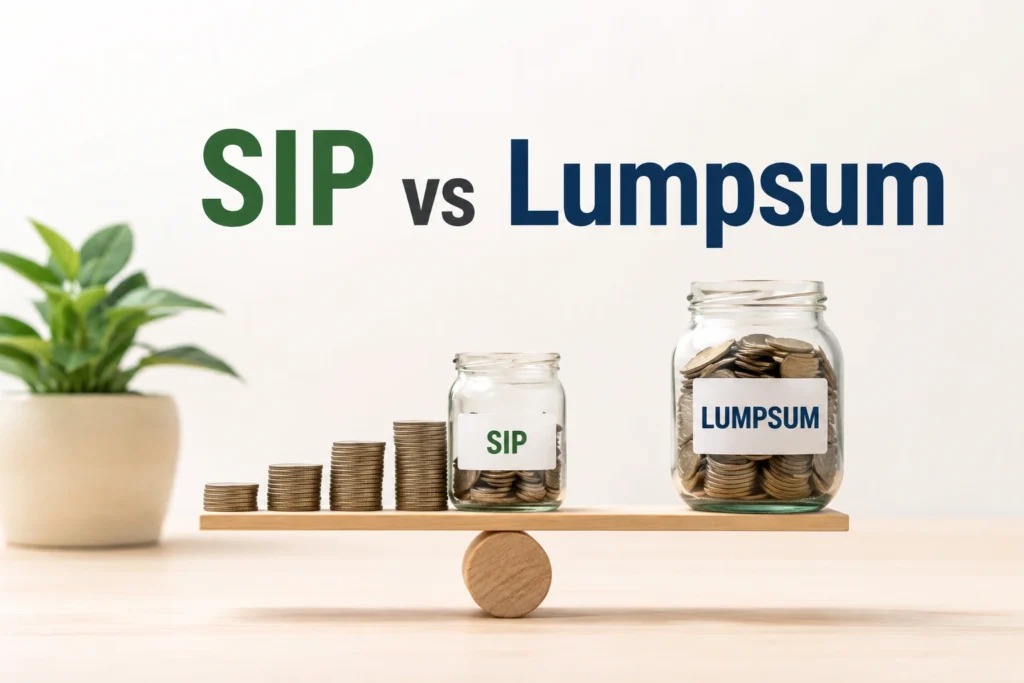
Many investors face the same question before starting their mutual fund journey: should they choose a Systematic Investment Plan (SIP) or invest a large amount at once through a lumpsum investment?
The SIP vs Lumpsum debate has been around for years because both approaches offer unique advantages. While SIPs help investors build discipline and reduce market timing concerns, lumpsum investments can maximize growth when markets are favorable.
Choosing between the two is not about finding a universally better option. It is about understanding which strategy aligns with your income pattern, investment goals, and risk appetite.
For a salaried professional, investing a fixed amount every month may feel comfortable. For someone who has received a bonus, inheritance, or proceeds from a property sale, a lumpsum investment may seem more practical.
This guide breaks down the key differences between SIP and lumpsum investing, helping you make a more informed decision for your financial future.
What Is SIP?
A Systematic Investment Plan (SIP) allows investors to invest a fixed amount in a mutual fund at regular intervals, usually monthly.
Instead of investing a large amount at once, you contribute smaller amounts consistently over time.
For example:
- ₹5,000 invested every month
- ₹10,000 invested every quarter
- ₹2,000 invested weekly
The amount is automatically deducted from your bank account and invested into the selected mutual fund scheme.
How SIP Works
Suppose you invest ₹5,000 every month in an equity mutual fund.
When markets are high, your money purchases fewer units.
When markets fall, the same amount buys more units.
Over time, this process averages your purchase cost, which is known as rupee cost averaging.
This feature makes SIP particularly attractive for long-term investors. SIP investing benefits from a concept known as dollar-cost averaging, which helps reduce the impact of market volatility over time.
Key Features of SIP
- Regular investments
- Affordable starting amount
- Automatic investing
- Rupee cost averaging
- Disciplined wealth creation
- Suitable for long-term goals
Who Should Consider SIP?
SIP is often suitable for:
- Salaried employees
- First-time investors
- Young professionals
- Investors with limited capital
- Individuals seeking disciplined investing
People who earn monthly income generally find SIP easier to maintain because it aligns with their cash flow.
What Is a Lumpsum Investment?
A lumpsum investment involves investing a large amount of money into a mutual fund in a single transaction.
Instead of spreading investments across months or years, the entire amount is invested immediately.
Examples include:
- Investing ₹5 lakh from a bonus
- Investing ₹10 lakh from property proceeds
- Investing inherited funds
- Investing retirement benefits
The money starts participating in market growth from day one.
How Lumpsum Investing Works
Imagine an investor receives ₹10 lakh and decides to invest it in an equity mutual fund.
The entire amount gets allocated at the current market level.
If markets rise afterward, the investor benefits significantly because all capital was invested earlier.
However, if markets decline immediately after investing, the portfolio value may temporarily decrease.
This makes market timing a more important consideration in lumpsum investing.
Key Features of Lumpsum Investment
- One-time investment
- Immediate market exposure
- Full capital participation
- Simpler transaction process
- Potentially higher gains in rising markets
Who Should Consider Lumpsum Investments?
Lumpsum investing may suit:
- Experienced investors
- Individuals with surplus capital
- Investors with long investment horizons
- Those comfortable with short-term volatility
It is commonly used when significant funds become available at once.
SIP vs Lumpsum: Understanding the Core Difference
The fundamental difference lies in how money enters the market.
Feature | SIP | Lumpsum |
Investment Style | Periodic | One-time |
Capital Requirement | Low | High |
Market Timing Risk | Lower | Higher |
Investment Discipline | Strong | Depends on investor |
Suitable for Salaried Individuals | Yes | Limited |
Suitable for Large Funds | Less common | Ideal |
Volatility Impact | Reduced | Higher |
Both methods can create substantial wealth over time. The difference often comes down to investor behavior and market conditions.
SIP vs Lumpsum: Benefits of SIP Investing
Understanding SIP advantages is essential when evaluating SIP vs Lumpsum options.
1. Reduces Market Timing Risk
Many investors struggle to identify the perfect time to invest.
Even professionals cannot consistently predict market movements.
SIP removes this challenge by investing regularly regardless of market conditions.
This creates a smoother investment experience.
2. Encourages Financial Discipline
Consistency plays a major role in wealth creation.
SIP develops the habit of investing before spending.
Over time, this discipline can significantly improve long-term financial outcomes.
3. Affordable for Most Investors
One of the biggest advantages of SIP is accessibility.
Many mutual funds allow investments starting from as little as ₹500 per month.
This enables beginners to start investing without waiting to accumulate a large amount.
4. Benefits from Rupee Cost Averaging
Market fluctuations become less intimidating with SIP investing.
When prices fall, investors acquire more units.
When prices rise, fewer units are purchased.
Over a long period, this helps average the purchase cost.
5. Supports Long-Term Financial Goals
SIP works well for goals such as:
- Retirement planning
- Child education
- Wealth creation
- Home purchase
- Financial independence
Because investments happen regularly, long-term goals become easier to achieve systematically.
SIP vs Lumpsum: Benefits of Lumpsum Investing
The SIP vs Lumpsum discussion would be incomplete without understanding where lumpsum investing excels.
1. Immediate Compounding Advantage
Compounding works best when money stays invested for longer periods.
With lumpsum investing, the entire capital begins compounding immediately.
This can create significant long-term wealth.
2. Potentially Higher Returns in Bull Markets
When markets are attractive and continue rising, lumpsum investments often outperform SIP investments.
This occurs because the full amount benefits from market appreciation from the beginning.
3. Simpler Investment Process
A single transaction can be easier to manage than multiple recurring investments.
Investors do not need to monitor monthly deductions or contribution schedules.
4. Ideal for Windfall Gains
Lumpsum investing is often suitable when investors receive:
- Annual bonuses
- Inheritance funds
- Business profits
- Property sale proceeds
- Retirement benefits
Instead of leaving money idle, investors can put it to work immediately.
SIP vs Lumpsum: Which Performs Better in Different Market Conditions?
One of the most common questions in the SIP vs Lumpsum debate is whether one strategy consistently delivers better returns.
The reality is that performance often depends on market conditions and investment timing.
During a Rising Market
Lumpsum investments generally have an advantage in strong bull markets.
Since the entire amount is invested from the beginning, every rupee participates in market growth.
For example, if an investor puts ₹10 lakh into a mutual fund before a sustained market rally, the gains can be substantial because the full capital benefits from the upward movement.
In such situations, lumpsum investing may outperform SIP investing.
During a Falling Market
SIP often performs better psychologically and strategically during market declines.
As prices fall, investors buy more units with the same investment amount.
This lowers the average purchase cost over time.
A lumpsum investor, on the other hand, may see a significant decline in portfolio value shortly after investing, which can create anxiety and lead to poor decisions.
During Volatile Markets
Volatility creates uncertainty.
This is where SIP’s averaging mechanism becomes valuable.
By investing across multiple market cycles, SIP reduces the impact of short-term fluctuations.
Investors who prefer stability often find SIP more comfortable during uncertain market periods.
SIP vs Lumpsum: Risk Comparison
Risk plays a major role when choosing between SIP and lumpsum investing.
Risk in SIP
SIP does not eliminate market risk.
The value of investments can still rise and fall.
However, SIP reduces timing risk because investments are spread over multiple dates.
This lowers the probability of investing all capital at a market peak.
Risk in Lumpsum
Lumpsum investments carry greater timing risk.
If markets decline immediately after investing, short-term losses can be significant.
Although long-term investors may recover over time, not everyone is comfortable with large fluctuations.
This is why investors should carefully assess their risk tolerance before choosing a lumpsum approach.
SIP vs Lumpsum: Return Potential
A common misconception is that SIP always generates higher returns.
In reality, neither strategy guarantees superior performance in every scenario.
When Lumpsum Can Generate Higher Returns
Lumpsum investing may outperform when:
- Markets are undervalued
- Economic growth is strong
- Investment horizon is long
- Capital is invested before a major rally
The earlier the money enters the market, the longer it can compound.
When SIP Can Deliver Better Outcomes
SIP may produce better results when:
- Markets are volatile
- Investors lack market timing expertise
- Income is earned regularly
- Emotional investing needs to be controlled
The true advantage of SIP often comes from consistency rather than higher absolute returns.
Factors to Consider Before Choosing SIP or Lumpsum
The best answer to the SIP vs Lumpsum question depends on your personal financial situation.
1. Source of Income
Consider how you receive money.
If you earn a monthly salary, SIP may be the natural choice.
If you receive a large sum at once, lumpsum investing may be more practical.
2. Investment Horizon
Longer investment horizons generally favor both strategies.
However, investors with shorter time frames should be more cautious with equity-oriented lumpsum investments.
3. Risk Appetite
Ask yourself:
- Can you tolerate short-term market declines?
- Will temporary losses affect your decisions?
- Are you comfortable with market volatility?
Conservative investors often prefer SIP because it feels less stressful.
4. Market Conditions
Although timing the market is difficult, valuation levels still matter.
If markets appear extremely expensive, some investors prefer staggering investments through SIP or a Systematic Transfer Plan (STP).
5. Financial Goals
Different goals require different approaches.
Examples include:
Goal | Suitable Approach |
Retirement Planning | SIP |
Child Education | SIP |
Wealth Preservation | SIP or Hybrid |
Investing Bonus Money | Lumpsum |
Inheritance Investment | Lumpsum |
Long-Term Wealth Creation | SIP or Lumpsum |
Can You Combine SIP and Lumpsum Investing?
Yes.
Many successful investors use both strategies together.
This approach offers flexibility and diversification in investment execution.
For example:
- Invest a bonus through lumpsum.
- Continue monthly SIP contributions.
- Increase SIP amounts during salary hikes.
- Invest windfall gains separately.
This hybrid strategy allows investors to benefit from both regular investing and immediate capital deployment.
Example of a Combined Approach
Suppose an investor has:
- ₹5 lakh available today
- ₹15,000 monthly surplus income
A practical strategy could be:
- Invest ₹5 lakh through a lumpsum investment.
- Start a ₹15,000 monthly SIP.
This ensures immediate market participation while maintaining long-term investment discipline.
“The individual investor should act consistently as an investor and not as a speculator.”
Benjamin Graham
Father of Value Investing
Common Mistakes Investors Make
Regardless of whether you choose SIP or lumpsum investing, avoiding these mistakes is important.
Trying to Time the Market Perfectly
Many investors wait endlessly for the “perfect” opportunity.
As a result, money remains idle and misses growth opportunities.
Stopping SIPs During Market Corrections
Market declines often create the best opportunities for long-term SIP investors.
Stopping investments during downturns can reduce future wealth creation.
Investing Without Clear Goals
Every investment should support a specific objective.
Without goals, investors often make emotional decisions.
Ignoring Asset Allocation
Choosing between SIP vs Lumpsum is only one part of investing.
Asset allocation across equity, debt, and other investments remains equally important.
Focusing Only on Returns
Returns matter, but risk management matters too.
An investment strategy should match both financial goals and emotional comfort levels.
SIP vs Lumpsum: Which Investment Option Is Better for You?
There is no universal winner in the SIP vs Lumpsum comparison.
The better choice depends on your circumstances.
Choose SIP if:
- You earn a regular income.
- You want disciplined investing.
- You are new to investing.
- You want to reduce timing risk.
- You prefer gradual wealth creation.
Choose lumpsum if:
- You have substantial surplus capital.
- You have a long investment horizon.
- You understand market volatility.
- You want immediate market exposure.
Many investors ultimately benefit from using both approaches together.
The goal should not be choosing the “best” method. The goal should be selecting the strategy that helps you stay invested consistently and reach your financial objectives.
Conclusion
The SIP vs Lumpsum decision depends on factors such as income pattern, risk tolerance, investment horizon, and available capital. SIP offers discipline, affordability, and reduced timing risk, making it attractive for most retail investors. Lumpsum investing provides immediate market exposure and can generate strong returns when invested during favorable conditions.
Neither approach is inherently superior. What matters most is staying invested, maintaining a long-term perspective, and aligning your strategy with your financial goals. Investors who understand their objectives and remain consistent often achieve better outcomes than those who constantly switch strategies based on short-term market movements.
FAQs
Is SIP better than lumpsum investment?
SIP is not always better than lumpsum investing. SIP helps reduce market timing risk and encourages disciplined investing. Lumpsum investing can generate higher returns when invested before a strong market rally. The right choice depends on individual circumstances and financial goals.
Can I convert my SIP investment into a lumpsum investment later?
Yes. Investors can stop SIP contributions and make lumpsum investments whenever they have additional capital available. Both methods can coexist within the same mutual fund portfolio.
Is lumpsum investment risky?
Lumpsum investing carries higher timing risk because the entire amount enters the market at once. If markets decline shortly after investment, short-term losses may occur. Long-term investors can often manage this risk more effectively.
Who should choose SIP investing?
SIP is generally suitable for salaried individuals, beginners, and investors seeking disciplined wealth creation. It allows investors to start with small amounts and build long-term financial habits.
Can I use both SIP and lumpsum investing together?
Yes. Many investors combine both strategies. They invest windfall gains through lumpsum investments while continuing monthly SIP contributions for long-term wealth creation.